FACTS
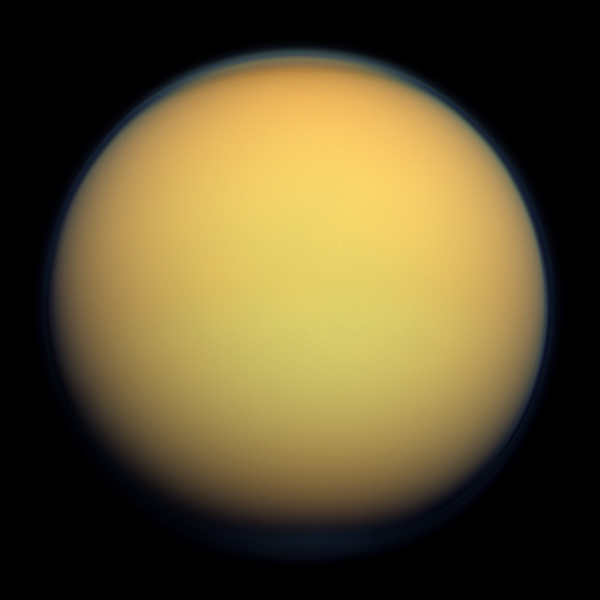
NASA’s Dragonfly rotorcraft, which is being built to fly on Saturn’s moon Titan, now has all seven of its science cameras, NASA said on Tuesday, Nov. 24. The cameras, called DragonCam and built by Malin Space Science Systems, were installed, tested and integrated by mid-November at the Johns Hopkins Applied Physics Laboratory (APL) in Laurel, Maryland, according to NASA. Dragonfly is scheduled to launch in July 2028 and reach Titan in late 2034.
What the Dragonfly rotorcraft is
Dragonfly is the first rotorcraft built to explore another world and will fly to many locations on Titan to study whether the moon could support life, according to NASA’s mission page. The car-sized lander weighs about 1,900 pounds (875 kilograms), is about 12.5 feet (3.85 meters) long and wide, and flies on eight sets of rotor blades, NASA said.
It is powered by a Multi-Mission Radioisotope Thermoelectric Generator supplied by the U.S. Department of Energy, with a battery to store energy, according to NASA. NASA said Dragonfly can cover tens of miles in under an hour and is planned to visit 20 to 30 sites over a primary mission of more than three years, traveling about 70 miles (115 kilometers) from its first landing site.
Seven cameras for Titan
Each DragonCam camera sits in an insulated housing and looks out through a window in a foam enclosure that protects it from Titan’s surface temperature of about minus 290 degrees Fahrenheit, NASA said. NASA described the cameras this way:
- A forward wide-angle camera with a 90-degree field of view and a forward medium-angle camera with higher resolution. Their views overlap to give a stereoscopic, or 3D, view of the terrain ahead.
- Two side-mounted wide-angle cameras for panoramic views.
- Two downward-facing wide-angle cameras to check whether a landing spot is safe for the lander’s drill and seismometer.
- A high-resolution microscopic imager aimed at the drill site to show details of millimeter-sized sand grains.
A light-emitting diode (LED) array built at APL, spanning infrared to ultraviolet light, will help scientists judge the color and makeup of surface materials, NASA said. During Titan’s night, which lasts nearly eight Earth days, the array may help identify organic molecules that glow under ultraviolet light, according to the agency. Two navigation cameras, also built by Malin Space Science Systems, were installed over the summer.
What the Dragonfly team said
“We’ll be able to see Titan from perspectives we’ve never had before,” said Elizabeth Turtle, Dragonfly principal investigator at APL, according to NASA.
“These will be our eyes to see and explore this whole new world,” said Michael Ravine, DragonCam development manager at Malin Space Science Systems and a Dragonfly co-investigator.
“DragonCam will give us critical context for the samples collected by DrACO,” said Carolyn Ernst, DragonCam instrument scientist at APL. DrACO is the Drill for Acquisition of Complex Organics, which will collect surface samples at several sites, NASA said.
Next steps for the lander
NASA said Dragonfly’s other instruments are scheduled for delivery, integration and testing over the next several months. They are the drill; the Dragonfly Mass Spectrometer (DraMS); the Dragonfly Gamma-ray and Neutron Spectrometer (DraGNS); and the Dragonfly Geophysics and Meteorology package (DraGMet), according to NASA’s mission page.
More science news is on the Stay Current News Science page.