FACTS
NASA’s Voyager 1 spacecraft will reach one light-day from Earth at 5:16:07 a.m. EST on Wednesday, Nov. 18, according to NASA. At that point it will be 16,094,799,096 miles, or 25,902,068,356 kilometers, away, so far that a radio signal traveling at the speed of light takes a full day to cross the distance. Voyager 1 launched on Sept. 5, 1977.
What one light-day means for Voyager 1
A light-day is the distance light travels in 24 hours, NASA explains on its Voyager 1 light-day page. The spacecraft will cross that mark 49 years, 2 months and 11 days after launch, traveling at about 38,000 mph, NASA said.
That means a command sent from Earth takes a day to reach the spacecraft, and its reply takes another day to come back. “If you want to say ‘hello’ to Voyager, you send your message and then you go home and you wait two days before you finally get a response,” Voyager project manager Suzanne Dodd of NASA’s Jet Propulsion Laboratory said in an Oct. 29 JPL update.
Voyager 1 entered interstellar space in August 2012 and is the most distant human-made object still returning data, according to NASA. In about 40,000 years, it will pass about 1.7 light-years from the star Gliese 445, NASA said.
A recent pause in contact
Voyager 1 is running low on power. Its radioisotope generators lose about 4 watts a year as their plutonium decays, JPL said. In early September, engineers turned off three devices on the spacecraft and replaced them with lower-power ones in a maneuver the team nicknamed the “Big Bang.” Without it, another science instrument likely would have had to be shut off as early as summer 2027, JPL said.
On Oct. 18 and 19, NASA’s Deep Space Network could not detect Voyager 1’s signal during two scheduled contacts. The signal returned on Oct. 20. The team found that one group of thrusters went offline and backups took over, and that the spacecraft’s fault protection appears to have been triggered. Engineers are still looking for the root cause, JPL said.
“This is the first time we’ve seen the spacecraft do something like this, but we are also at a point in the mission where we have to expect the unexpected,” said Kareem Badaruddin, Voyager mission manager at JPL.
Voyager 1 launched with 10 science instruments. Some were turned off after its planetary flybys, and power limits have forced the team to shut off two more in recent years, according to JPL.
Read more science news from Stay Current News.
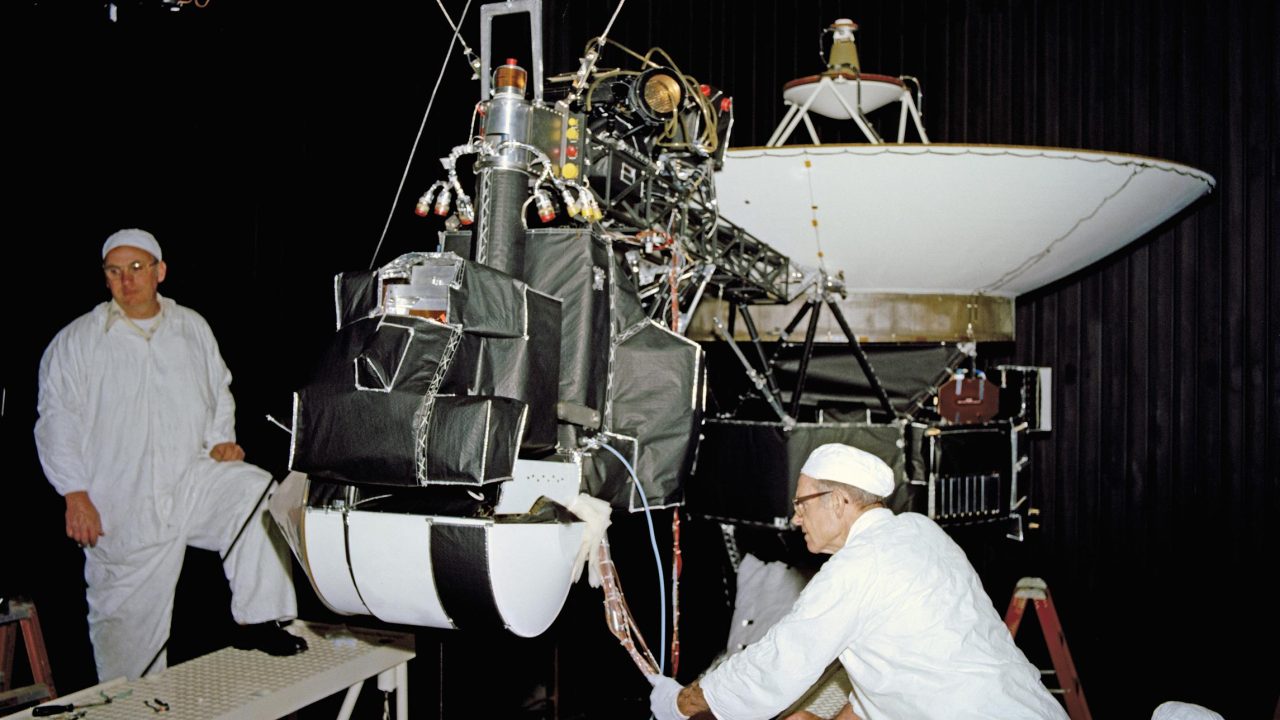
Photo: File photo of a Voyager spacecraft being tested in JPL’s 25-foot space simulator in 1977. NASA/JPL-Caltech, public domain.