FACTS
The U.S. Supreme Court on Friday, Nov. 13, agreed to hear the Trump administration’s appeal of lower-court rulings that found the Trump asylum proclamation at the southern border unlawful. The case, Mullin v. Refugee and Immigrant Center for Education and Legal Services (No. 26-239), challenges the order President Donald Trump signed on his first day back in office that suspended access to asylum for migrants who cross the U.S.-Mexico border. A decision is expected before the court’s term ends next summer.
What the court ordered
The grant appears in a Supreme Court order dated Nov. 13. The justices limited their review to the first two questions in the government’s petition. The same order also accepted an unrelated securities case involving Robinhood Markets.
According to Roll Call, the justices will consider whether the executive order is legal and whether a lower-court judge could issue an order protecting all asylum seekers, not only the people who sued. Roll Call reported that the policy remains in effect while the case continues.
The court’s action is separate from Mullin v. Al Otro Lado, a case about the older “metering” practice of turning back asylum seekers before they reach the border. The court ruled 6-3 for the administration in that case on June 25, 2026, SCOTUSblog reported.
What the Trump asylum proclamation does
The proclamation declared an “invasion” at the southern border and used that finding to deny asylum claims by people who present themselves there, Roll Call reported. It relies on Section 212(f) of the Immigration and Nationality Act, according to the American Civil Liberties Union, which represents the challengers.
U.S. District Judge Randolph Moss in Washington ruled that the policy exceeded the president’s authority, The Hill reported. SCOTUSblog reported that Moss held that neither the Constitution nor federal immigration law lets the president “adopt an alternative immigration system.” The U.S. Court of Appeals for the D.C. Circuit upheld that ruling on April 24, 2026, according to the court’s docket. Judge J. Michelle Childs wrote that the president may have power to temporarily block entry, but not the “expansive removal authority” the proclamation claims, SCOTUSblog reported.
The administration’s argument
The administration argues that the president has broad authority over asylum, which it describes as a discretionary benefit. “The proclamation thus lawfully suspends access to asylum, which is a purely discretionary benefit,” the government’s petition states, according to Roll Call. The petition also says the lower court “elevates empty procedures over substance” and points to reductions in illegal border crossings.
Solicitor General D. John Sauer called the policy Trump’s “main tool” for stopping illegal crossings, The Hill reported. In the August petition, described by SCOTUSblog, Sauer wrote that the appeals ruling “threatens to dismantle” a tool that Homeland Security Secretary Markwayne Mullin calls “indispensable” for border control. He also argued that the nationwide class of asylum seekers is an “end-run around” the court’s 2025 ruling in Trump v. CASA, which limited universal injunctions.
The challengers’ argument
The challengers are a nationwide class of people barred from seeking asylum under the proclamation and three legal service groups: RAICES, Las Americas Immigrant Advocacy Center and the Florence Immigrant & Refugee Rights Project, according to an ACLU statement. They argue that Congress created the asylum system and that the president “may not invent by fiat a new removal system that eviscerates the protections Congress mandated by statute,” Roll Call reported, quoting their brief.
“The president does not have the right to unilaterally override the protections Congress has afforded those fleeing danger,” said Lee Gelernt, lead counsel and deputy director of the ACLU’s Immigrants’ Rights Project, in the group’s statement. The challengers also argue that illegal crossings were already declining before the order, The Hill reported.
What comes next
The ACLU said it expects arguments in spring 2027. Roll Call reported that the justices will likely hear arguments and decide the case before the end of the term in June.
More coverage is in the Stay Current News Politics section.
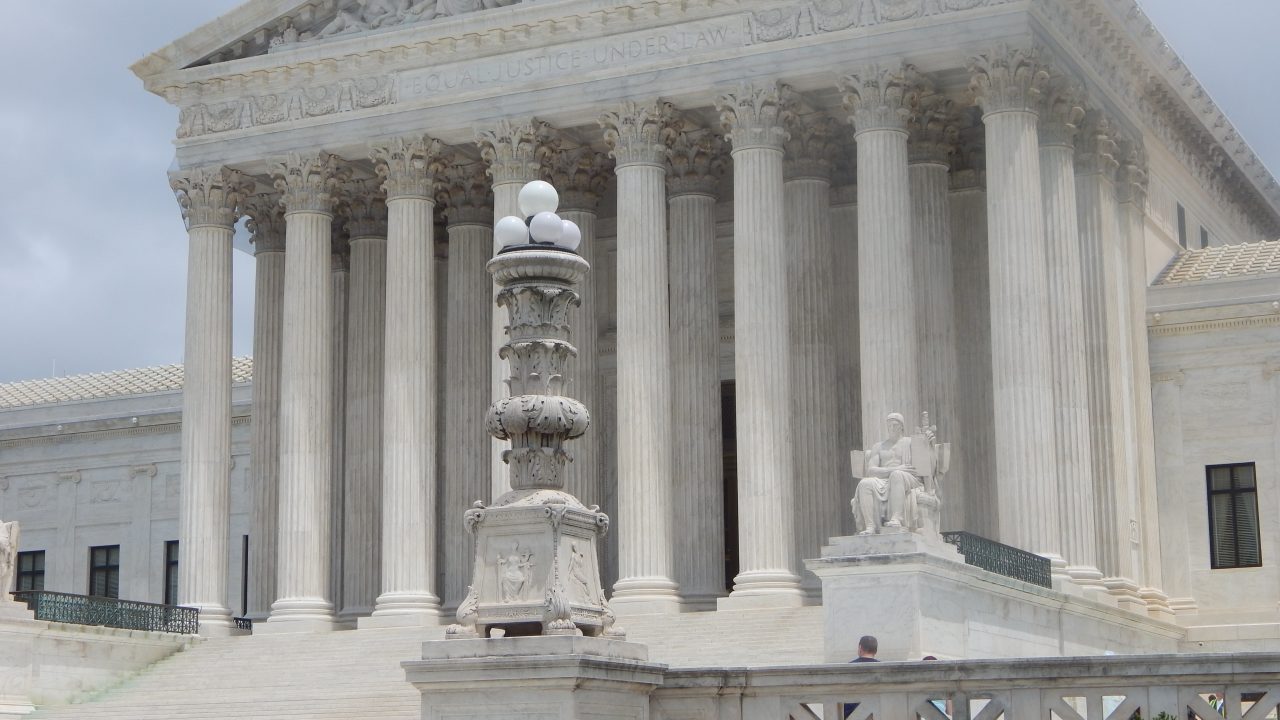
Photo: File photo of the U.S. Supreme Court Building in Washington. Laura Choate / Wikimedia Commons, CC BY-SA 3.0.