FACTS
US flu activity is rising in many parts of the country and is “higher than typically observed at this time of year,” the Centers for Disease Control and Prevention said in its weekly FluView report released Friday, Nov. 13. The report, covering the week ending Nov. 7, counted two more flu-associated deaths of children, bringing the 2026-2027 season total to five, according to the CDC. Nearly all of the flu viruses subtyped by public health labs were influenza A(H1N1).
What the latest US flu activity data shows
Of 52,287 specimens tested by clinical labs during the week, 11.3% were positive for flu, the CDC reported. That was up from 9.1% the week before, according to CIDRAP, the University of Minnesota’s infectious disease news service.
Influenza-like illness accounted for 3.2% of outpatient visits, above the national baseline of 2.9%, the CDC said. The prior week’s figure was 2.8%, according to Clinical Lab Products, which reported on the CDC’s previous update. Flu was the discharge diagnosis for 2.2% of emergency department visits, up from the prior week.
Hospitals in the CDC’s NHSN reporting network recorded 9,584 lab-confirmed flu admissions during the week, a rate of 2.8 per 100,000 people. A separate CDC network, FluSurv-NET, has counted 3,262 lab-confirmed flu hospitalizations since Oct. 4.
The CDC estimates there have been at least 2.6 million illnesses, 36,000 hospitalizations and 2,100 deaths from flu so far this season. A week earlier, the agency’s estimate was at least 1.7 million illnesses, 25,000 hospitalizations and 1,400 deaths, Clinical Lab Products reported.
Where flu is highest
Seven jurisdictions had high or very high levels of influenza-like illness, one very high and six high, up from two the week before, the CDC reported. CIDRAP identified them as California, Louisiana, Oregon, South Carolina, Tennessee, Texas and Washington. Activity was moderate in Colorado, Florida, Hawaii, Idaho, Massachusetts, New Jersey, New Mexico, New York state and Puerto Rico, according to CIDRAP.
The CDC said its Regions 4, 6, 9 and 10 were above their regional baselines for influenza-like illness.
H1N1 leads virus samples
Public health labs reported 680 flu viruses during the week, of which 670 were influenza A and 10 were influenza B, the CDC said. Of the 460 influenza A viruses that were subtyped, 98.9% were A(H1N1)pdm09 and 1.1% were A(H3N2).
In the previous week’s update, 140 of 147 H1N1 viruses tested, or 95.2%, were well recognized by the reference antisera used to assess vaccine match, Clinical Lab Products reported.
The CDC said no new confirmed human infections with a novel influenza virus had been reported as of Nov. 7. Clinical Lab Products reported in its coverage of the prior week that Washington state had confirmed two new human H5 infections, one of them fatal.
Deaths and severity
The two pediatric deaths reported this week occurred during the current season, the CDC said. One more death from the 2025-2026 season was also reported, bringing that season’s pediatric total to 203. Flu accounted for 0.4% of all deaths during the week, the CDC said.
The CDC’s preliminary assessment classifies the severity of the season so far as low across all age groups, though the agency said that could change. The CDC said that “an earlier increase in activity does not necessarily lead to a higher seasonal peak or greater overall severity.”
What the CDC says about vaccines and treatment
“Annual seasonal influenza (flu) vaccination is recommended,” the CDC said in the report, noting that flu vaccines are available for people 6 months and older. The agency also said prescription antiviral drugs can treat flu and “should be started as early as possible.”
Other respiratory viruses remain lower for now. CIDRAP reported that COVID-19 cases are low, with wastewater levels moderate in most of the country, and that RSV cases are low.
More coverage is in the Stay Current News Health section.
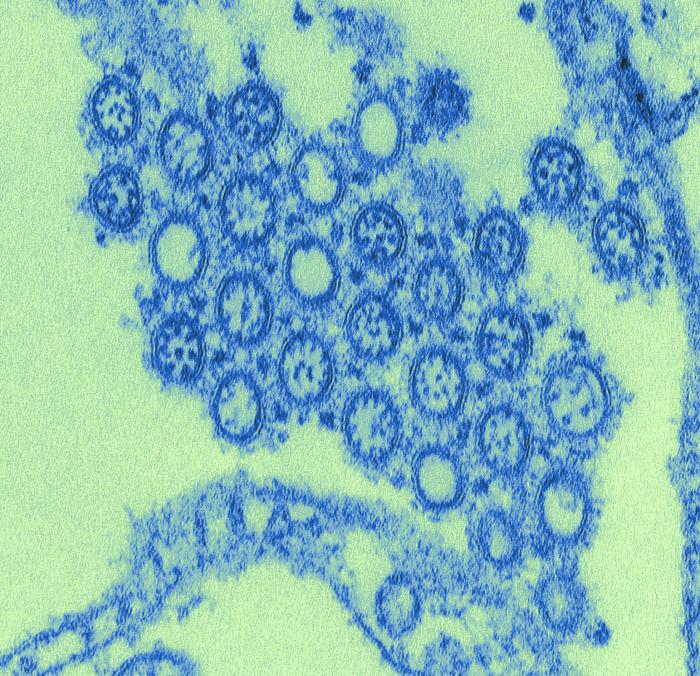
Photo: File photo of 2009 pandemic influenza A(H1N1) virus particles under a transmission electron microscope. CDC / Cynthia Goldsmith / CDC Public Health Image Library, public domain.