FACTS
U.S. Central Command said on Friday, Nov. 13, that U.S. forces shot down two Iranian drones headed toward Bahrain and that no one was hurt and nothing was damaged. Iran’s Islamic Revolutionary Guard Corps said its forces had struck a U.S. early warning radar in Bahrain, a statement the U.S. military rejected. Separately, the Guard said a gas tanker hit a naval mine in the Strait of Hormuz, a report that could not be independently verified, the Associated Press reported.
What CENTCOM said about the Iranian drones
Central Command, which oversees U.S. forces in the Middle East, responded to the Guard’s statement in a post on X. “The IRGC launched two one-way attack drones toward Bahrain and both were shot down by U.S. forces,” the command said, adding, “There were no injuries or damage,” according to Middle East Monitor and the Indian news agency ANI. The post described the Guard’s radar statement as a claim and its own account as the fact.
The Associated Press reported that Bahrain’s Ministry of Information did not immediately respond to requests for comment. Bahrain is home to the headquarters of the U.S. Navy’s Fifth Fleet, Al Jazeera noted.
What Iran’s Revolutionary Guard said
Iran’s state-run IRNA news agency, citing a Guard statement, said the attack on the radar was a response to a U.S. strike on a telecommunications pole in the southern Iranian port of Sirik, the AP reported. Euronews reported that Iranian state media placed the Sirik attack on Thursday, Nov. 12.
The Guard described the radar strike as “a serious warning to the aggressor enemy to end its aerial provocations,” according to the Fars News Agency as reported by ANI. “If the enemy repeats its violations and acts of aggression, the IRGC Aerospace Force is on full alert to respond,” the Guard said.
The AP said it was Iran’s first reported targeting of a facility in Bahrain since September. Reuters, in a report carried by Al Jazeera, said it was the first Iranian attack Iran has reported on U.S. military assets in a Gulf country since early September.
Tanker reported hit by a mine in the Strait of Hormuz
The Guard also said a tanker struck a mine and suffered an explosion while sailing through the eastern part of the Strait of Hormuz, and that the vessel had “ignored repeated warnings,” the AP reported. The AP described the ship as a liquefied petroleum gas tanker and said the claim could not be independently verified. The U.K. Maritime Trade Operations center had no immediate report of the incident, according to the AP.
Reuters reported that the Guard’s navy, citing state media, said a tanker carrying liquefied natural gas had used an “unauthorized and dangerous route” before it was hit. Reuters said no details on the tanker were immediately available. The two news agencies described the cargo differently, and neither reported the ship’s name or flag.
Iranian media reported on Thursday that four oil tankers were hit by explosions after ignoring warnings and entering areas Iran considers restricted, according to Reuters. The Washington Institute for Near East Policy counted at least 10 ships hit in the first 10 days of November, after 37 attacks in October, Reuters reported.
Background to the U.S.-Iran conflict
Iran targeted U.S. bases in Arab neighbors, including Bahrain, during an air war that began in February in retaliation for U.S. strikes, and has routinely targeted oil tankers in the Strait of Hormuz since then, the AP reported.
Central Command said on Wednesday that U.S. forces continue to “work around the clock keeping the Strait of Hormuz open for commercial shipping” while “strictly enforcing the ironclad naval blockade against Iran,” Euronews reported. The command said about 1.7 billion barrels of crude oil have passed through the strait under U.S. protection since the summer.
In a separate development reported by the AP on Friday, a confidential report by the International Atomic Energy Agency said Iran maintains that inspections of its nuclear sites cannot resume while it faces U.S. threats.
More coverage is in the Stay Current News World section.
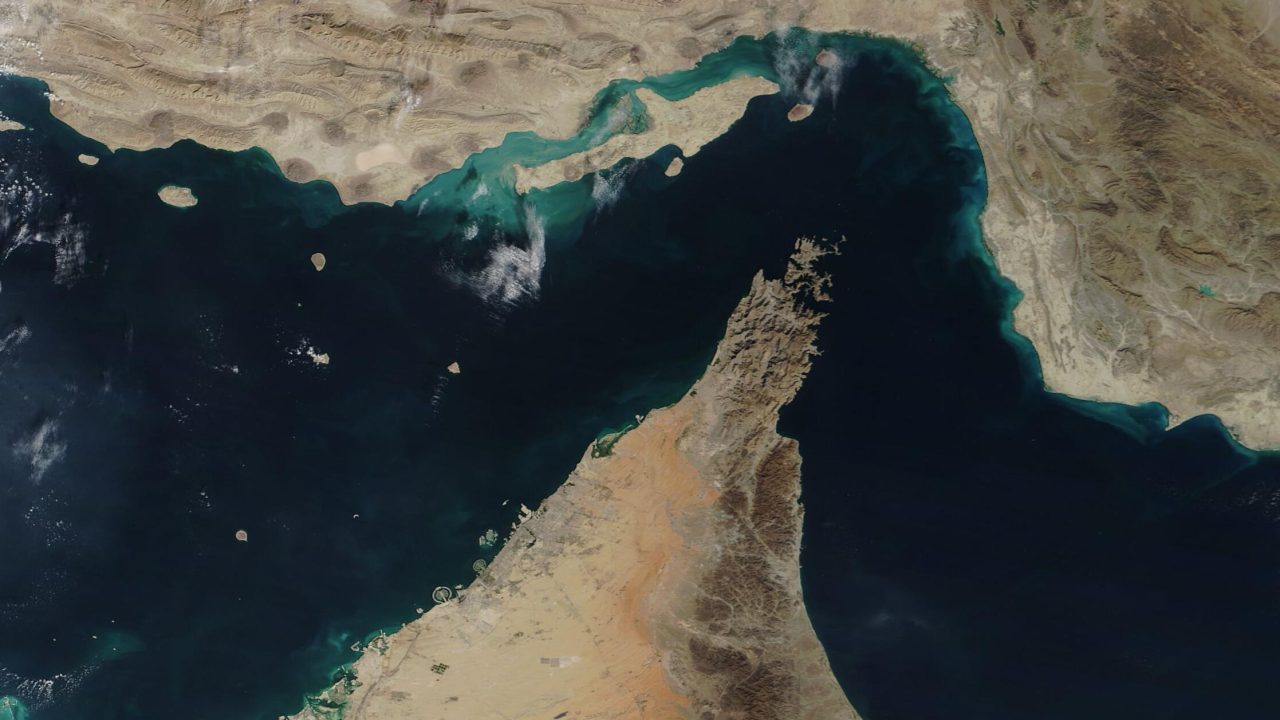
Photo: File photo of the Strait of Hormuz taken by NASA’s Terra satellite. NASA / Wikimedia Commons.jpg), public domain.