FACTS
The nationwide FAA ground stop that halted departures at all U.S. airports was lifted at 8:15 p.m. Eastern time on Friday, Nov. 13, after more than four hours, Transportation Secretary Sean Duffy said. Duffy blamed overloaded, aging telecommunications equipment, while federal officials said they had found no sign of a cyberattack and were still investigating the cause.
This story updates Stay Current News’ Nov. 13 report, FAA ground stop halts departures at all U.S. airports, with the lifting of the order and the investigation into its cause.
How the FAA ground stop ended
Instability in radar and communications systems began around 3:36 p.m. ET, Duffy said, according to a U.S. Department of Transportation summary of his remarks. The FAA ordered the ground stop at 3:54 p.m. ET, ABC News reported. More than 3,500 airplanes were in the air at the time, the department said.
“We didn’t lose all telecom, we didn’t lose all radar,” Duffy said, according to the department, which described the stop as a precaution against intermittent outages rather than a total loss of systems. Duffy said recovery would be slow because crews must be available and aircraft must be moved into position. “It’s going to be slow,” he said, according to Al Jazeera.
What officials say caused the outage
Duffy said the system relies on old analog telecom equipment. “Our switches, our routers, actually got overloaded with data, and they went down,” he said, according to Nextgov/FCW. He said newer IP switches that had already been installed did not go down. “It’s the old hardware that went down,” he said, according to the Transportation Department. He also said the FAA’s SMART tool, which gives controllers prompts they can accept or reject, was not connected and could not have affected the outage.
Homeland Security Secretary Markwayne Mullin said the incident did not appear to be a cyberattack. “There’s no chatter, we haven’t seen any footprints,” he said, according to SecurityWeek. “However, we’re still looking, so we’re not going to rule that out.” Mullin said the FAA had been applying patches and installing new equipment, which “was overwhelming the older system,” SecurityWeek reported. He said the National Security Agency, the Defense Department and the Cybersecurity and Infrastructure Security Agency were involved.
Reports point to a software update
Bloomberg, citing a person familiar with the matter, reported that the FBI does not believe a cyberattack or criminal activity caused the outage and is examining a software update as a possible cause, according to SecurityWeek. Officials have not confirmed that account or announced a root cause.
CBS News, citing multiple sources, reported that an update to the private communications network linking the air traffic control system caused it to reboot, and that it crashed when it rebooted, according to SecurityWeek and The Register. The Register reported that the network, the FAA Telecommunications Infrastructure, is managed by L3Harris and connects more than 4,400 facilities. L3Harris had not responded to a request for comment, The Register reported.
Flights canceled, diverted and delayed
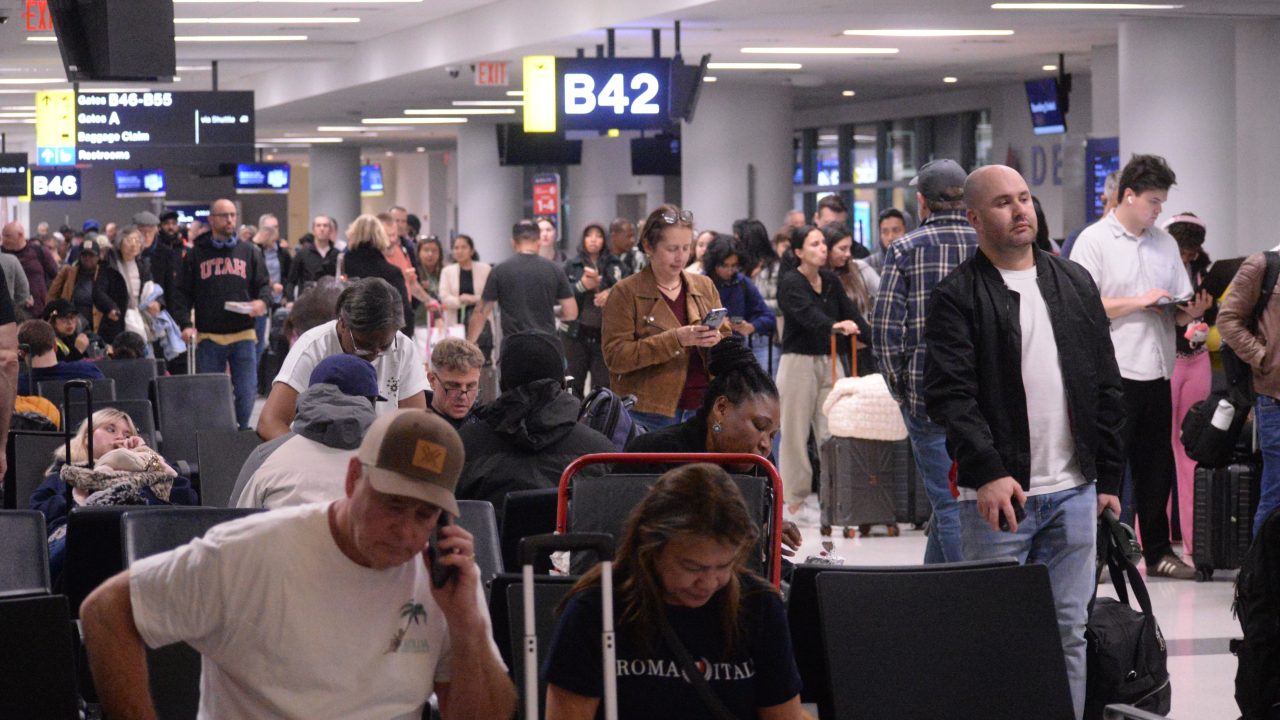
Flight data firms gave different totals. Flightradar24 counted more than 4,700 flights canceled and 10,000 delayed on Friday, Al Jazeera reported. FlightAware counted more than 8,860 cancellations on Friday, Euronews reported. By 7:05 p.m. ET, at least 827 flights had been diverted, with 670 returning to their departure airports and 157 going elsewhere, according to Cirium data cited by Al Jazeera.
Disruptions continued Saturday, Nov. 14. Flightradar24 reported 700 Saturday flights already canceled, Al Jazeera said, and FlightAware later counted about 2,650 Saturday cancellations to or from the U.S., according to Euronews. United, Delta and American said they were resuming operations. American said it was “positioning the airline for the strongest possible recovery in the days ahead,” Euronews reported.
Duffy said he expected operations to be “back up and operational” in time for Thanksgiving travel, ABC News reported.
GAO warning and calls for funding
A Sept. 14 report from the Government Accountability Office on the FAA’s air traffic control modernization said that, as of May 2026, the agency had replaced 2,560 of 5,170 “old and frail copper wires” with fiber optic cable. The GAO found the FAA had 11,389 separate project schedules that were not integrated, and warned the agency “could end up causing air traffic disruptions” if it put speed ahead of cost and schedule planning.
Duffy called on Congress to pass emergency funding of another $50 billion for air traffic control, Nextgov/FCW reported. Congress approved $12.5 billion for the effort in 2025. Sen. Maria Cantwell said the Senate Commerce Committee would review the problems, and Sen. Tammy Duckworth said she would demand answers from the FAA, ABC News reported.
More national news is on the Stay Current News U.S. page.