FACTS
California is waiting for a final report on Project Nexus, a solar canal pilot in Turlock, before deciding whether to fund more projects that place solar panels over irrigation canals, KQED reported. The pilot is a partnership of the Turlock Irrigation District, UC Merced, the California Department of Water Resources and the firm Solar AquaGrid. KQED first published its report on Sept. 21, 2026, and updated it Nov. 10, saying the final report is due later this year.
What the solar canal pilot is testing
KQED reported that the pilot tests three designs: a wide canopy shaped like a barn roof over a canal more than 100 feet across, conventional slanted panels over a canal about 20 feet wide, and retractable panels set low over a narrow canal that can be rolled up like an accordion.
The project is funded with $20 million from the state general fund, provided through the Department of Water Resources, according to the Turlock Irrigation District. The district accepted the money on Feb. 8, 2022. Construction over the 20-foot canal was finished in March 2025, and panels over the wider canal were completed and commissioned in August 2025, the district said. The narrow-span site also includes 75-kilowatt iron-flow batteries.
The district lists the pilot’s output as more than 1.6 megawatts. District spokesperson Josh Weimer told KQED the project is a “proof of concept” producing about 1.7 megawatts, compared with 56 megawatts from a solar farm the district runs in the desert.
Early observations on algae and water
Shading the water reduced the growth of algae and aquatic weeds, KQED reported, which can lower maintenance costs and improve water quality. Weimer told KQED that when the canal was drained after the irrigation season, “there was a physical line on the sun side” separating algae growth from the shaded side.
Researchers are measuring temperature, relative humidity, wind speed and incoming radiation, and are testing a prototype that measures evaporation directly, UC Merced research professor Roger Bales told KQED.
Bales co-wrote a 2021 study that helped persuade the state to fund the pilot. His early calculations, as reported by KQED, estimate that covering 100 miles of Turlock’s narrow canals could save enough water for 2,700 households a year, and covering 100 miles of its wide canals could save enough for 11,000. He estimated 100 miles of canals could generate 330 to 1,400 megawatts, enough for 77,000 to 304,000 households.
How the idea started
Solar AquaGrid co-founder Jordan Harris told KQED the idea came while driving between Los Angeles and San Francisco, after living in France, where trees line canals. “And so I started thinking, could we do something similar in California?” he said. Harris co-founded the firm with Robin Raj in 2015, according to the University of California.
The 2021 UC Merced study, published in Nature Sustainability, estimated that covering California’s roughly 4,000 miles of open canals could save up to 63 billion gallons of water a year, the UC newsroom reported. A follow-up analysis estimated about 13 gigawatts of power potential.
Why the state is studying it
California has pledged to move to 100% clean electricity by 2045 and now gets 62% of its electricity from renewable and zero-carbon sources, KQED reported. UC Davis researchers estimate the state’s water supply could shrink by up to 25% by 2050, according to KQED.
Building over canals also avoids developing open land. “These are disturbed spaces,” Harris told KQED. KQED cited a Nature Conservancy study finding solar projects on open space take 621 days on average to permit, compared with 110 days on developed land.
Limits and other approaches
Canal operators often do not own the land around canals or the transmission lines needed to move power, KQED reported. Turlock’s panels sit high enough for crews to clean the canal, including by dragging an anchor chain to clear weeds.
The Contra Costa Water District, which manages 48 miles of canals built in the 1930s that now run past backyards and parks, plans to move its water into pipes instead to cut evaporation, spokesperson Jennifer Allen told KQED. “This isn’t gonna be the only way to do it,” Weimer said.
Department of Water Resources spokesperson Andrew Schwarz told KQED the state will review the final report before any further investment, with a focus on “evaluation, continued study, potential scaling and lessons learned.”
More coverage is in the Stay Current News Science section.
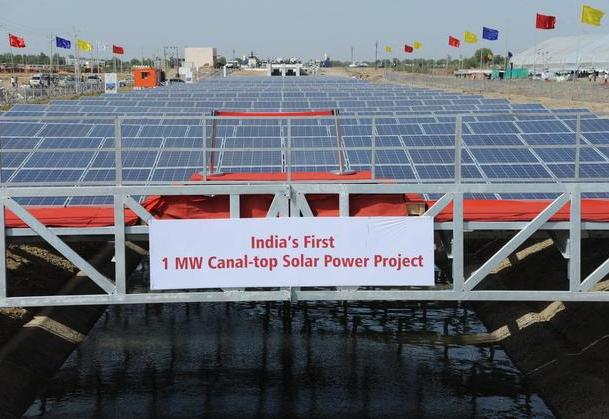
Photo: File photo of a canal-top solar plant near Kadi in Gujarat, India, not the Turlock project. Hitesh vip / Wikimedia Commons, CC BY-SA 3.0.