FACTS
Transportation Secretary Sean Duffy said on Saturday, Nov. 14, that work by the contractor L3Harris on an FAA network set off Friday’s nationwide FAA ground stop, TechCrunch reported. Officials said they had found no sign of a cyberattack. Cancellations continued Saturday as airlines worked to get planes and crews back in place.
This story updates Stay Current News’ reports FAA ground stop halts departures at all U.S. airports and FAA ground stop lifted as officials investigate cause of outage with the officials’ account of the cause.
What caused the FAA ground stop, according to officials
Duffy said L3Harris was upgrading copper lines to fiber at a remote location, which he called “pretty straightforward work,” according to TechCrunch. A router involved in that work then overloaded the system, he said. Duffy said the work took place around 3 p.m. Friday and that officials were looking at “whether we had incompetence.” He added: “There will be reevaluation of when we do this work.”
In remarks reported by Yahoo News, Duffy said a router “started flooding other routers” and that “we don’t believe this was cyber at all.” He also said, “I’m stuck with L3Harris,” according to Yahoo News.
Rebecca Guy, the FAA’s acting chief technology officer, said two places were “pinging our network at a very high rate,” about “a thousand connections over every four to five seconds,” TechCrunch reported.
FAA Administrator Bryan Bedford said there was “zero evidence of anything nefarious and zero evidence of anything AI-related,” according to TechCrunch.
L3Harris and controllers respond
L3Harris said in a statement: “We are supporting the FAA in its investigation to understand the conditions that led to the Nov. 13 ground stop.” The company added that it “takes the nationwide ground stop and its impact on travelers, airlines and air traffic operations seriously,” according to news reports.
Nick Daniels, president of the National Air Traffic Controllers Association, said, “We know we didn’t have communications with airplanes.” He added: “I don’t think blame changes anything. Action changes things.”
Flights still recovering
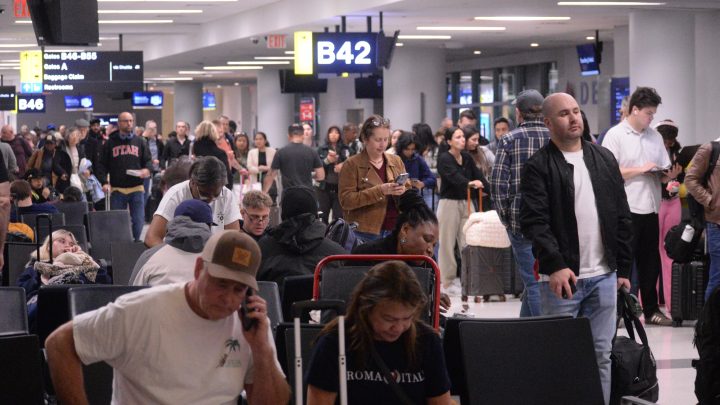
More than 6,400 U.S. flights were canceled on Saturday as of 9 p.m. Eastern time, according to FlightAware data cited by Yahoo News, above the 4,000 to 5,000 the FAA had predicted. About 800 Sunday flights had been canceled by that point, led by American Airlines with 293 and JetBlue with 241. Bedford said about 12,000 flights could not be completed on Friday.
Bedford said he expected schedules to be fully back to normal “by the close of business on Sunday.” “I do think the worst is behind us,” he said, according to news reports.
What travelers can do
Travelers with flights on Sunday should check their airline’s app or website before going to the airport. Under U.S. Department of Transportation rules, passengers whose flights are canceled are entitled to a refund if they choose not to travel.
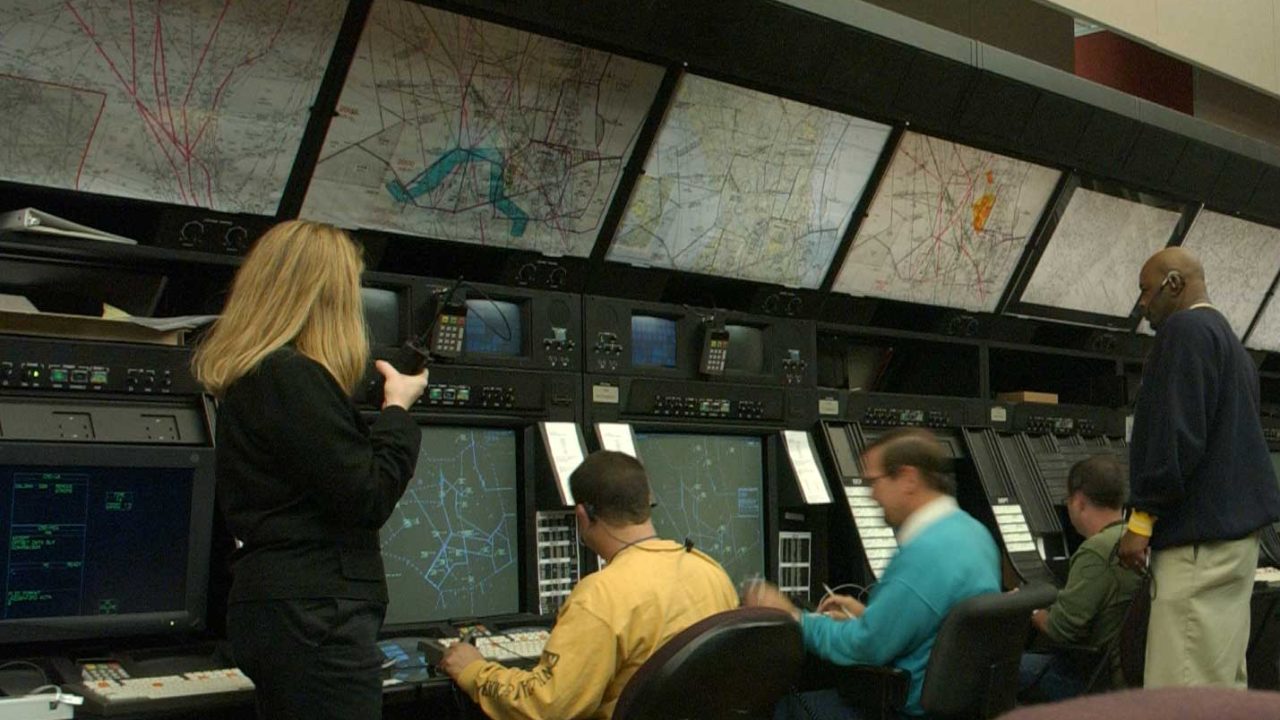
Photo: File photo of air traffic controllers at the FAA’s Washington Air Route Traffic Control Center. U.S. government / Wikimedia Commons, public domain.